Tuesday, December 3, 2013

Amazon testing Drones for Delivery!

Wow: science is advancing at increasingly fast rates!  Check out what Amazon is testing and thinking about...


Amazon says it will take years to advance

Photo credit: AP


Amazon's plan to eventually enlist self-guided drones to deliver packages to customers in 30 minutes or less, revealed Sunday night on CBS' "60 Minutes," opens a host of possibilities -- and hazards.
Amazon.com Inc. says it's working on the so-called Prime Air unmanned aircraft project in its research and development labs. The company admits it will take years to advance the technology and for the Federal Aviation Administration to create the necessary rules and regulations.
Amazon CEO Jeff Bezos said in the prime-time interview that while his octocopters look like something out of science fiction, there's no reason they can't be used as delivery vehicles.
Bezos said the drones can carry packages that weigh up to five pounds, which covers about 86 percent of the items Amazon delivers. The drones the company is testing have a range of about 10 miles, which Bezos noted could cover a significant portion of the population in urban areas.
Bezos told "60 Minutes" the project could become a working service in four or five years.

Read more here:

Thursday, October 31, 2013

How Trains Go Around Corners

Here is a link to some nice hands-on "kitchen science" from the Naked Scientists:


In the early 19th century there were various forms of horse drawn railway and the wheels were held on the track by big flanges. These worked but they would rub against the rails creating friction and making a horrible noise. A neat solution was found, probably by accident when they started casting the wheels. When you cast a wheel it will naturally have a slight slope on it to get it out of the mould.
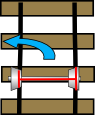
They tried putting the wheels on the axels both ways round. If the wheel is smaller on the outside it means that if the axle moves slightly to the left the wheel is bigger on that side so it steers back onto the track.
Correction from the top
Wrong correction from the top
Wheels sloping outward
Wheels sloping inward
But if the wheel is bigger on the outside and moves to the left, the axle will turn to the left and quickly fall off the track as you found.
If the track is too sharply curved the cone shape of the wheels can't cope and the flanges of the wheels do rub against the rails making a horrible noise and wearing out the track. Most tracks don't corner this sharply.
If you deliberately push the wheels at an odd angle it can overshoot and take a wobbly swaying path down the rails, this is one reason why old trains often sway gently, though modern suspension is a lot better at coping with this.

Read more here:

http://www.thenakedscientists.com/HTML/content/kitchenscience/exp/train-tracks-how-trains-go-round-corners/